When the burdens lessen, what remains is the essence of homecoming itself—returning home with a peaceful heart and arriving with happiness.
Jakarta (ANTARA) – Morning at the Gelora Bung Karno (GBK) sports complex had traces of dew when Sri Yuniarti, a woman preparing to return home for Eid, clutched the hand of her young daughter.
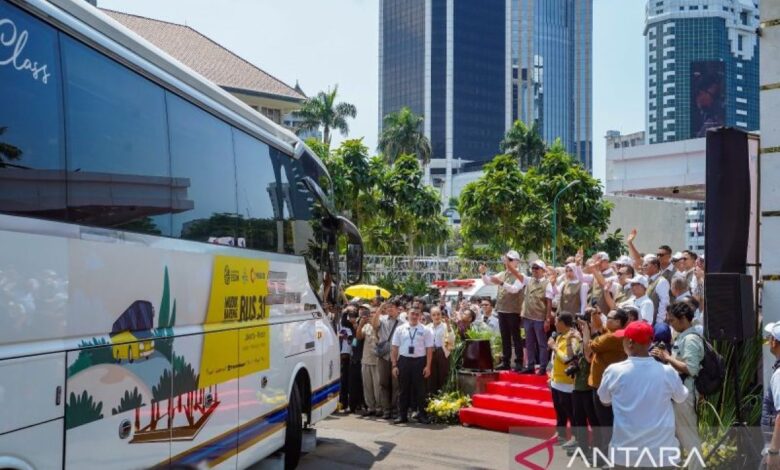
Although Eid was still days away, that did not slow her steps to start the homecoming journey. In front of her, a fleet of buses was stationed in formation with engines running, awaiting the boarding of passengers.
Yuniarti carried her small bag containing clothes and snacks, little gifts for her parents in Klaten, Central Java, for her journey home.
The bag seemed heavy, though it seemed like heaviest thing was not the luggage but the longing she had quietly held over the past year amid the hustle and bustle of Jakarta.
For her, returning home is not just a physical journey. homecoming is a chance to become a child again, not just a mother or a worker.
In moments like this, for those going home, the distance between the city and the village is no longer measured in kilometers but in the warmth of awaited embraces.
“I have joined the Free Homecoming Program for three years, and I am very happy. The service is excellent, everything is great. We feel ease and joyful,” she said.
Her story reflects the experiences of millions participating in Indonesia’s annual homecoming tradition. Each year, a significant demographic shift occurs as citizens concurrently travel to their places of origin.
Busy roads, crowded stations, terminals buzzing with neatly stacked suitcases and boxes. Behind it all, there is one common thread connecting travelers, the longing they hope to fulfill.
Yet, behind the sacredness of the homecoming journey lies realities that are not always light. Rising transportation costs, long and tiring journeys, and uncertainty amid crowded travel often become a burden for many families.
Many have to reconsider their plans or postpone their wish to visit their families to maintain financial stability.
At this point, the meaning of homecoming shifts from merely tradition to a matter of access. Who can go home, and who must wait?
This question is crucial amid an economic condition that requires many families to calculate expenses carefully, including for homecoming.
Related news: Indonesia promotes child-friendly travel for Eid homecoming
Free homecoming trips
The existence of free group homecoming programs became an answer to this concern. Homecoming is not just about transportation but about reopening opportunities for many to return home without being burdened by costs.
When travel expenses are reduced, families can also allocate funds to share with parents, help relatives, or bring small joys to their hometown.
Free homecoming programs organized by both government and private entities need to be continuously promoted.
Among those who routinely organize this program is the state mining industry holding, MIND ID, along with its group members—ANTAM, Bukit Asam, INALUM, TIMAH, and Vale Indonesia.
This year, as a form of government’s support, they sent 1,700 travelers using 28 buses and 4 ships, showing a real form of private involvement for communities longing to return home.
Other businesses also run similar free programs, demonstrating that the role of the private sector goes beyond mere business activities.
Facilities provided by free homecoming programs are complete—from travel kits such as t-shirts, hats, neck pillows, to medicines and meals—offering safety and comfort.
Thus, the journey is no longer only about reaching the destination but about arriving in good condition, without excessive fatigue.
Besides Yuniarti, there was Fikro, a housekeeping worker at the Directorate General of Mineral and Coal, Ministry of Energy and Mineral Resources, who also benefited from the program.
He appeared in a hurry to catch the bus, but his face reflected relief. Amid his busy work schedule, the opportunity to travel home was meaningful.
“I hope programs like this continue to be held so that more people can feel their benefits,” he said.
Related news: Indonesia deploys teams to secure Eid homecoming routes nationwide
Making journey lighter
Yuniarti and Fikro’s experiences show that easier homecoming trip is not just a slogan. It is a real experience that changes how people view the journey home.
From anxiety-filled trips to calmer ones, from heavy burdens to lighter ones.
Furthermore, the free homecoming program shows how collaboration between government, businesses, and society can create real solutions.
When all parties work together, problems that were once annual burdens can be managed more effectively. Homecoming no longer rests solely on the individual but becomes part of a mutually supportive ecosystem.
It is not just about moving from one point to another but about maintaining quality of life, strengthening social bonds, and ensuring everyone has the same opportunity to feel the joy of returning home.
Amid evolving economic and mobility challenges, such an approach to traveling home is increasingly relevant.
When the buses departed, what moves was not only the wheels. Hopes were found, and people started to find their way home again.
If supported, the long homecoming journey can feel lighter and more humane. When the burdens lessen, what remains is the essence of homecoming itself—returning home with a peaceful heart and arriving with happiness.
Related news: Police forecast March 24 as start of busy Eid al-Fitr return traffic
Editor: M Razi Rahman
Copyright © ANTARA 2026
Source link