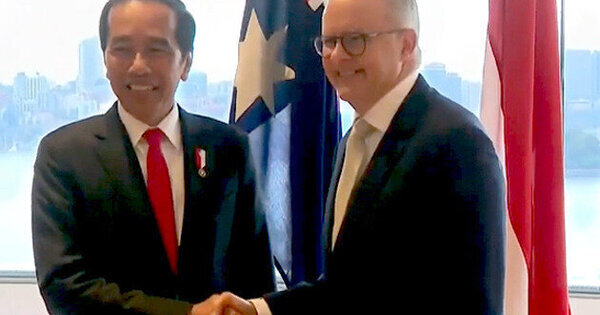
A developing opportunity between Australia and Indonesia could underpin a green powerhouse partnership in a net-zero world, but coal-fired processing, downstreaming rules and geopolitics keep straining progress, writesTyson Parker.
CANBERRA AND JAKARTA have spent years pitching agreen economicpowerhousepartnership, but coal-fired processing, downstreaming rules and investment viability have slowed progress.
Imagine an electric vehicle built on an Indonesian assembly line and powered by a battery developed fromAustralian lithium and Indonesian nickel.
This is the vision of two neighbours who, despite some turbulence over the years, have found a potent bilateral economic opportunity in the resources and manufacturing sectors.
Historically, the relationship between Australia and Indonesia has been described as significant butunderdeveloped.
How Indonesia can rebuild trust before the next election
Gas shortages, poisoned school meals and rising distrust expose the growing gap between power and people in Indonesia.
Around 2015, Indonesia was Australias 13th largest trading partner, sittingbehind smaller marketssuch as New Zealand and Malaysia.
Two-way tradereached about $34.8 billion in 202425, elevating Indonesia to Australias ninth-largest two-way trading partner.
Indonesia isprojectedto overtake Australias economy in nominal GDP (measured at market exchange rates) before 2030, making it a powerful economic player within the Indo-Pacific region and an increasing priority for Canberra.
Negotiationstowards a comprehensive trade deal began in 2010, but progress stalled soon after, knocked off course by events such as the2013 surveillance scandalrevelations.
Formal trade talks restarted in 2016, culminating in the Indonesia-Australia Comprehensive Economic Partnership Agreement (IA-CEPA), signed in March 2019 and commencing in July 2020.
This agreement marked a step forward in the bilateral economic relationship and shifted the dynamic into mutual economic cooperation across key areas.
It created the scaffolding for joint economic programs and business-to-business dealmaking and heightened economic integration, including the elimination or lowering of tariffs.
IA-CEPA came just after the two countries elevated their relationship to a Comprehensive Strategic Partnership (CSP) in August 2018, which provided a formal framework for enhanced cooperation and committed to deeper coordination across a range of areas.
The CSPframes cooperation across:
- economic partnership;
- people-to-people links;
- shared security;
- maritime cooperation; and
- supporting a stable regional order (includingASEANcentrality).
This architecture shows up through long-running instruments like Australia Awards,development partnershipssuch as Kemitraan Indonesia Australia Untuk Infrastruktur (KIAT) and regular security and maritime coordination.
President Prabowo faces new nemesis: Press accountability
Indonesia’s President-elect has displayed a fear of journalists and has taken steps to control the media.
Additionally, there has been a concerted effort from both sides to link key industries, forming the basis of aneconomic powerhouse model.
This is an attempt to combine Australias critical minerals, technology and know-how with Indonesias manufacturing scale and capabilities, creating a shared value chain in key sectors.
In theory, it is a neat division of labour, but in practice, the partnership runs into three hard constraints. Indonesias downstreaming rules, the carbon intensity of current processing and the pull ofmajor-powercapital and geopolitics.
InNovember 2023, the Australian and Indonesian governments signed a memorandum of understanding to establish a bilateralmechanism to progresscollaboration in the electric vehicle ecosystem.
The stakes are long-term and to capitalise, both countries are looking to utilise the energy transition as a joint strategic economic transformation.
For Australia, the partnership represents a crucial avenue for trade diversification and economic security as it seeks to become arenewable energy superpower.
For Indonesia, it is apathway to achievehigh-income country status by 2045 through the downstream processing of its vast natural resources (particularly nickel) and industries critical for a net-zero world.
Australiadominates lithium mining and is a top five producer of cobalt, whileIndonesiahas significant nickel, manganese and copper deposits.
The proposedsupply-chainwould feed Australias critical minerals (primarily lithium) and skills into Indonesian processing and manufacturing, with finished battery components and electric vehicles exported to third markets.
Australian investmentin Indonesiaremainssmall andoutsidethe top 20 economies in which Australia invests. Meanwhile, Indonesias nickel processing boom has been built largely withChinese capitaland is stillheavily poweredby coal.
Rare earth elements: The minerals at the heart of the next world crisis
Rare earth elements have become the new battleground for global dominance, fuelling weapon production, environmental fallout and international power struggles.
The partnership is currently navigating Indonesias downstreaming rules andresource nationalism, thecarbon intensityof existing processing and the gravitational pull ofmajor-powercapital, especiallyChinas entrenched positionin Indonesias nickel industry.
These are the driving factors that are hindering the process of integrating the two economies.
Indonesiasdownstreamingand resource nationalisation agenda includes a layer offoreign ownershipcontrolsandregulatory expectations, which shifts bargaining power towards Jakarta and raises perceived risk for foreign investors.
Jakartas downstreaming settings and local participation expectations mean foreign partners often have to negotiate equity, offtake, technology transfer and onshore processing commitments in exchange for access and approvals to engage with Indonesian markets.
Investor navigationof Indonesias legal environment and the permitting and regulatory system has been described as slow and difficult.
Althoughreformsintended to streamline key areas have been enacted in recent years, uncertainty still delays the kind of processing and industrial infrastructure the partnership needs.
That risk can be enough to stall long-term mining and processing commitments, though there are indications thatIndonesia is expandingits openness to foreign ownership and investment.
There is also friction between Western Environmental, Social and Governance (ESG) standards and the reality of Indonesian production.
Much of Indonesias nickel processing is still powered by captive coal generation, producing a carbon profile that sits poorly with ESG frameworks guiding many Australian investors.
The resultis a financing asymmetry, where projects that struggle to raise capital from Australia can still be built with capital that is less strictly constrained by those frameworks, such as from China.
Indonesiaslong-standingbebas aktif (free and active) posture gives it room to accept capital from wherever it comes.Chinese firmsare deeply embedded, withmultibillion-dollarintegration projects underway.
What Australia can learn from electric vehicle policies in Indonesia
The Indonesian Government is making an effort to encourage drivers to go electric in an effort to reduce traffic and air pollution.
For Australia, that intersects awkwardly with a strategic posture increasingly aligned with the United States through arrangements likeAUKUS.
In parts of Indonesias security and policy establishment,AUKUShas been met with concern about escalation and bloc dynamics, inspiring an atmosphere that can strain confidence needed for deep, long-term economic integration.
With both China and Australia looking to develop an improved economic relationship with Indonesia in similar sectors, Indonesia has options, suggesting that Australia may have less negotiating power at these friction points.
Theres also a quieter structural tension, in which both governments want to escape thedig-and-shipmodel andcapture downstreamvalue at home.
That creates overlap, even competition, in areas like battery components and cell manufacturing, where both sides are trying to attract the same investment and subsidise the same steps in the chain.
Although slow and far from perfect, progress is being made.
Australia has put funding on the table, including the $200 millionKINETIKpartnershipand the $40 millionKatalis program, which backs efforts by Australian firms to introduce grid-scale battery storage capability into Indonesia.
Much of the practical work is meant to run through Katalis, an IA-CEPA program designed to fund feasibility studies and early-stage partnership development in areas like battery supply chains and key infrastructure.
IndonesiasOrganisation for Economic Co-operation and Development (OECD) accession push also signals an interest in aligning with international standards, largely servicing itsdomestic goals under its2045 Golden Indonesia vision.
Although progress is ongoing, a fully developed economic powerhouse is far from a certainty, with a workable partnership requiring further policy alignment and concessions on the part of both nations.
Tyson Parkeris a freelance journalist, photographer and researcher based in South-East Queensland.
Related Articles
- How Indonesia can rebuild trust before the next election
- Indonesia’s new capital city project is an ongoing disaster
- Widodo’s son to continue family’s political dynasty
- Indonesia elected former military officer with autocratic streak
- Indonesia failing to inject energy into upcoming election
Source link