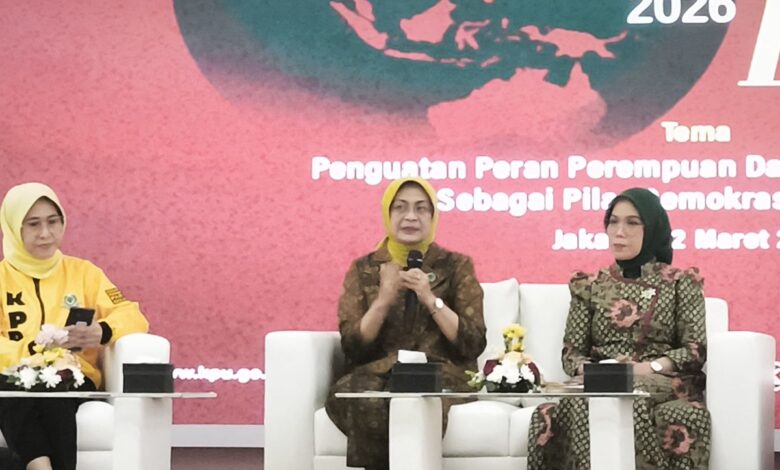
The ministry’s Deputy for Gender Equality, Amurwani Dwi Lestariningsih, highlighted that women possess significant capacity to play a role in politics, including at the regional level.
“Even without extensive support, we have already seen how women can become political representatives and become members of the legislature,” she said during an Indonesian General Elections Commission (KPU) seminar in Jakarta on Thursday.
The seminar, held to commemorate International Women’s Day, was themed “Strengthening the Role of Women in the Electoral Process as a Pillar of Substantive Democracy.”
Lestariningsih noted that various studies show women’s representation in parliament continues to face both structural and social challenges.
In the last two decades, affirmative policies to increase women’s representation have been implemented at various levels of legislative bodies, from the House of Representatives (DPR) to the Regional Legislative Councils (DPRDs).
However, their implementation is considered uneven between regions.
Data highlighted by the ministry indicates that only about 25 electoral districts successfully met the target of at least 30 percent women’s representation in the elections. Meanwhile, there are still approximately 16 regions with no female legislative members at all.
She argued that the candidacy mechanisms within political parties often put women in less strategic positions, thereby reducing their chances of being elected.
Beyond systemic factors, she remarked that gender stereotypes and social pressure still hinder women’s active involvement in politics.
“Women often do not receive sufficient structural support, even from within their own family environments,” she added.
According to her, there is still a wide gap between women and men based on the Gender Development Index, which measures three interrelated aspects: education, health, and economy.
Educational disparities are seen as a factor that hinders women’s ability to access economic opportunities and strategic positions.
She concluded that increasing women’s representation cannot rely solely on formal regulations; it also requires a shift toward a more inclusive political system and culture through collaboration between the government, political parties, election organizers, and civil society.
Related news: Indonesia’s Bawaslu launches political education for first-time voters
Related news: Political education could help prevent identity politics: BRIN
Related news: KPU, National Library partner for election and political education
Translator: Devi Nindy, Raka Adji
Editor: Azis Kurmala
Copyright © ANTARA 2026
Source link