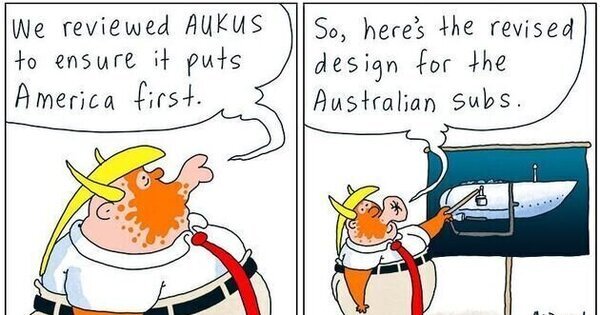
Three years ago, on a sunny mid-March day at San Diegos Point Loma U.S. naval base, Anthony Albanese signed Australia up to quite possibly the worst deal in our history.
Beside our aviator glass-wearing PM on that day, were the then-British PMRishi Sunakand U.S. PresidentJoe Biden.
Both have since departed the stage. AUKUS needs to as well.
Since Federal Labor without independent scrutiny or consultation tied a nuclear anchor around its neck, the global situation has worsened, and nuclear threats and risks have increased.
This was reflected in theJanuary 2026 risk assessment, which concluded the Doomsday Clock was sitting at 85 seconds to midnight. This is the closest point to Armageddon in the initiatives nearly eight-decade existence closer than during theCuban Missile Crisisand the chilliest stretches of theCold War.
The February 2026 expiry of theNewStart arms constraint agreementbetween Russia and the USA the two nations that hold more than 90 per cent of the worlds nuclear weapons means that for the first time in 50 years, there are no constraints on nuclear weapons numbers or deployment.
AUKUS and the submarine illusion: Australias $368 billion surrender
As Washington debates whether it can spare the submarines, Canberra continues to pay for vessels it may never fully control.
Multiple nuclear-weapon states are currently involved in active conventional wars:
- Israel vs Palestine and Iran;
- USA vs Iran; and
- Russia and North Korea vs Ukraine.
Senior military and political figures have threatened the use of nuclear weapons in some of these conflicts.
In March,France embraced an elevated role for nuclear weapons in Europeand for the first time flagged ‘a nuclear strike could be carried out as a warning’.
Confidence in international institutions, multilateral non-proliferation instruments and humanitarian law is low, with nuclear-weaponstates increasingly viewing compliance with such mechanisms as optional.
Against this background of dramatically elevated nuclear threat, Australia is increasingly stepping towards a nuclear-focused defence posture.
The AUKUS military pact with two nuclear-weapon state allies is being rapidly advanced and calls for greater scrutiny and debate.
AUKUS upgrades toHMAS Stirling(WA) andRAAF Tindal(NT) are being fast-tracked, and raise the very real prospect of these facilities providing operational support and enabling potential dual-use (conventional and nuclear) submarines and B52 bombers.
The Australian Government’s policy is to accept nuclear ambiguity from our AUKUS partners in effect, we dont ask and they dont tell whether visiting submarines, ships or aircraft are carrying or capable of carrying nuclear weapons.
At Senate Estimates in December 2025 senior Defence officials, including the newly appointed Australian Ambassador to the U.S.Greg Moriarty, acknowledged there is “no impediment”under Australian policy or treaty obligations to the visit of dual-capable platforms an aircraft, submarine or missile designed to carry either conventional weapons or nuclear weapons and that Australia would continue to respect the U.S. policy of neither confirming nor denying the presence of nuclear weapons.
There are also growing calls for clarity on the role and support played by key joint U.S.-Australian military facilities especiallyPine Gapin the NT in providing support for U.S. military operations in Iran.
Treaty the planets best chance to get rid of its worst weapons
From Jakarta to the Vatican, Prime Minister Albanese’s journey underscores a global call to ban the world’s most destructive weapons.
These questions are fundamental to our security and sovereignty, but they are ones the Australian Government prefers to avoid.
Australia can and must take real steps to “lower the temperature”.
As a middle power with a bipartisan history of often constructive engagement in international arms control and efforts to reduce weapons of mass destruction, Australia has both the ability and responsibility to take clear action to reduce nuclear threats.
Meaningful steps along this path include:
- Clearly committing to not acquire our own, or enable our allies’ nuclear weaponson or in Australian lands, seas or skies.
- Signing the Australian civil society bornU.N. Treaty on the Prohibition of Nuclear Weapons. In 2018, the Labornational platformcommitted to this action. It is time to advance this critical AUKUS guardrail.
- Holding a public or open parliamentary inquiry into the AUKUS arrangement including its risks, costs and alternatives.
(It is important to note that the Australian Peace and Security Forum have begun aninquiry, in the absence of any parliamentary one, and this initiative deserves support.)
- Withholding Australian uranium supply to nuclear weapon states with which we have bilateral sales arrangements, that are not meeting their international disarmament obligations. This includes France, UK, USA, China and India note there is a precedent with Russia as the Abbott Government suspended uranium sales in September 2014 in response to the downing of Malaysian Airlines MH17.
- Outlining the rules of engagement and the checks and balances around the provision of targeting and military operational data supplied from Australian joint facilities.
- Applying diplomatic pressure to nuclear-weapon states to meet their disarmament obligations during theU.N. N.P.T.(Treaty on the Non-Proliferation of Nuclear Weapons). Review conference in New York from 27 April to 22May 2026. In December 2025, Foreign MinisterPenny Wongdescribed the NPT as the cornerstone of disarmament and non-proliferation. It is time to demonstrate this.
- Reinforcing, championing and demonstrating compliance with international humanitarian law and rights-based standards and norms.
Against the backdrop ofembedded ADF personnel on U.S. subs sinking Iranian vesselsin international waters, unexpected U.S. military uses of air force bases in WA, the executive deployment of forces and weaponry to the Gulf region, and the increasing Trump tractor beam towards unbridled and unlawful war-fighting, Australia and Australians must use this third anniversary as a time to review, reflect and recalibrate on what we stand for and against. And on whose terms and in whose interests.
Dave Sweeneyis theAustralian Conservation Foundation’snuclear-free campaigner and was a founding member ofICAN. You can follow him@nukedavesweeney.
Related Articles
- Australias $300b AUKUS bet hinges on Britains submarine capacity
- Mark Carneys warning: Albanese is choosing weakness for Australia
- AUKUS and the submarine illusion: Australias $368 billion surrender
- When America raises the bill, Australia pays the price
- Invisible no more: How drone warfare exposes AUKUS strategic blind spot
Source link